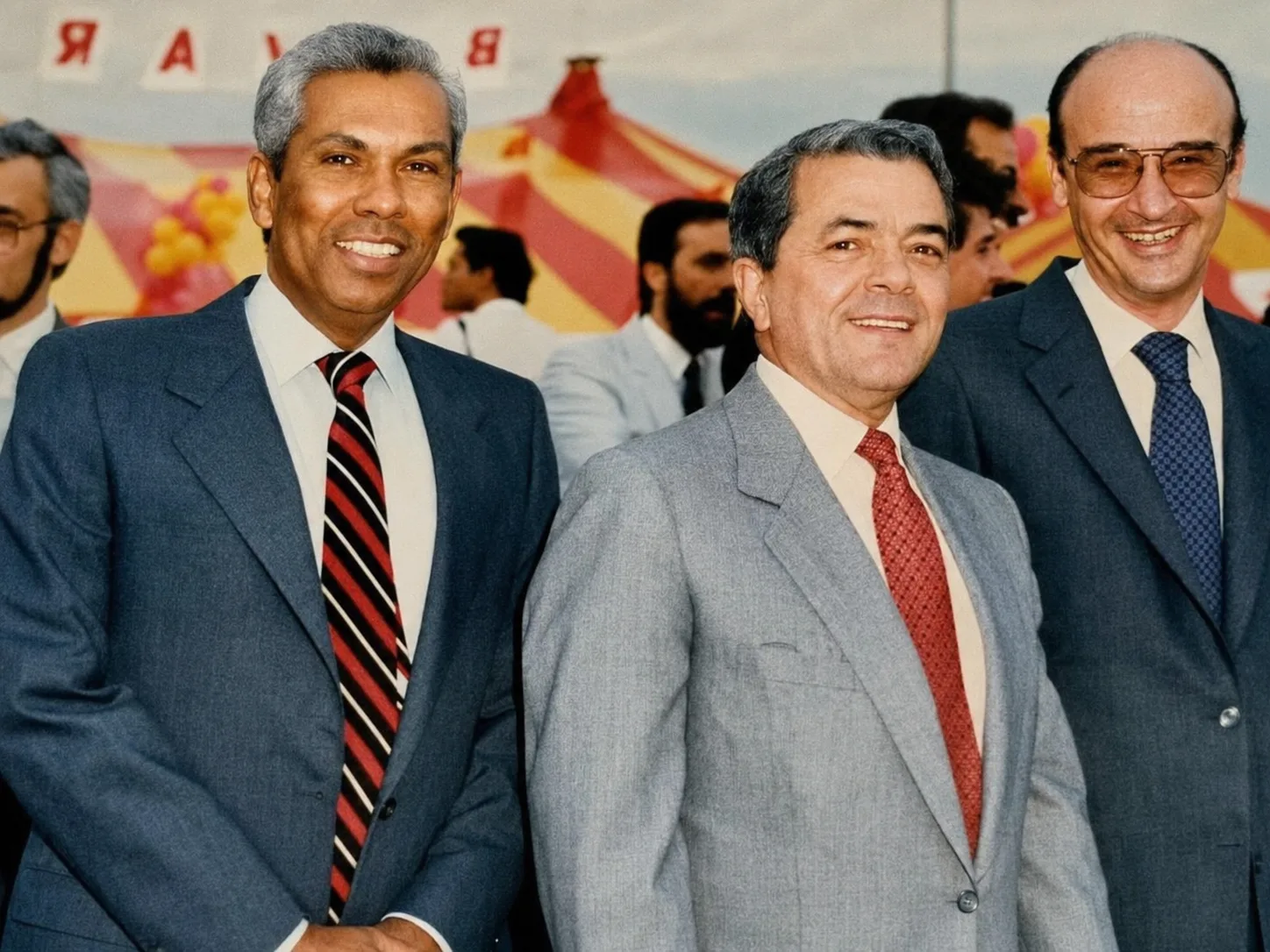
Colombian business history records few episodes as decisive, and at the same time as poorly documented, as the Santo Domingo family's recovery of control over Bavaria S.A. in the late 1960s. Bavaria was not just a powerful company: for decades it was the largest company in the country. Despite being the largest private shareholder after the 1967 merger with Cervecería Águila, the Santo Domingos found themselves in a paradoxical position: they could not exercise the control that legitimately belonged to them, because of irregular practices — so-called "window powers of attorney" — that distorted the true will of the shareholders. It was in that setting that lawyer Pedro Bonett Locarno appeared, designing and executing the legal strategy that restored corporate legality and returned effective control of the company to the Santo Domingo family.
Although the Santo Domingo Group had a formal corporate structure — presidents, vice presidents, boards of directors — the real operation was different: in the effective organizational chart, the one that truly set the conglomerate's course, Bonett held a position above all of them. No Group executive had the closeness, the trust, or the strategic influence with Julio Mario Santo Domingo that he did; more than an outside advisor, he was the Group's intellectual center.
Origins
He was born in Santa Marta but spent his childhood and adolescence in Ciénaga, Magdalena, a region shaped by the presence of the United Fruit Company; his father, Pedro Bonett Camargo, worked for the company and left such a mark that Ciénaga's municipal library now bears his name. That environment shaped his social sensibility early on. He traveled to Bogotá to study Law at Universidad Libre, where he trained in labor law, constitutional law and cassation, and rounded out his preparation with an executive-management program at Universidad de los Andes: an exceptional combination of legal and business vision for the time.
Meeting Cepeda Zamudio and the Santo Domingos
Shortly after graduating he met the writer Álvaro Cepeda Zamudio, a central figure of the Barranquilla Group — the circle that gathered Gabriel García Márquez, Alejandro Obregón, Alfonso Fuenmayor and Germán Vargas, among others. The friendship between the two was decisive: Cepeda, a close friend of Julio Mario Santo Domingo, introduced him to the family, beginning a professional and personal relationship that would last more than four decades.
The control crisis at Bavaria (1967–1968)
When the merger between Cervecería Águila — owned by the Santo Domingos — and Bavaria S.A. was finalized in 1967, the family received not cash but shares of Bavaria, immediately becoming its largest private shareholder. In any modern corporate system, that position should have translated into decisive influence over the board of directors. But Bavaria was dominated by groups that used "window" proxies — documents collected en masse, often without shareholders understanding their scope — to vote large blocks of shares they did not actually own. The result was a corporate injustice: the will of the largest shareholder was effectively nullified. Tensions rose to the point that President Carlos Lleras Restrepo himself announced he would personally attend the 1968 shareholders' meeting to prevent "the Santo Domingos from taking over the company" — a politically powerful statement, but a legally mistaken one: the family was not seeking to take over anything, but to exercise a right it already held. Against that backdrop, Bonett was tasked with designing the legal strategy to dismantle the irregular practices and return to the Santo Domingos the control that rightfully belonged to them.
Bonett's political paradox
Before becoming the Santo Domingos' trusted lawyer, Bonett had been a figure of the Colombian left: he rose to Secretary General of the Colombian Communist Party, with solid political training and deep convictions. He was expelled for two reasons that reveal who he truly was: he never accepted armed struggle — he believed justice should be built through law, not through a rifle — and he saw no contradiction between social equality and the virtues of a market economy, an unacceptable position for the communist orthodoxy of the time. That balance — intellectual left, Marxist training and a belief in markets — marked the rest of his life and made him a unique figure in the country: a Marxist-Leninist who ended up as the legal strategist of Colombia's most powerful industrialist; a former communist leader who forged an intimate friendship with Julio Mario Santo Domingo, sustained for more than four decades by loyalty, trust and affection; a man able to move comfortably among businessmen, intellectuals, politicians, military officers and artists, without ever losing his personal coherence. Semana magazine summed him up with a phrase reserved for exceptional figures: he was wanted by the left, the right, business people and the military alike. That cross-cutting respect did not come from his ideology but from his character: consistent, discreet, brave and deeply ethical — qualities that, far from clashing with his legal practice, made him more sensitive to corporate injustices and sharper at discerning where legitimacy truly lay. Perhaps that is why, through that uncommon combination of clarity, sensitivity and courage, Julio Mario Santo Domingo trusted him absolutely: not only as a lawyer, not only as a strategist, but as a friend. For four decades he was the person Santo Domingo turned to on the most complex and decisive matters — what the press would eventually call, over time, "the man behind…"
The Bonett strategy (1968–1971)
1968: the first clash. The 1968 shareholders' meeting was the starting point; although it did not yet produce the definitive change, it revealed something crucial: Bavaria's power structure rested on manipulable practices, vulnerable to systematic legal intervention.
1968–1971: the quiet rebuilding. For three years, Bonett carried out meticulous, surgical work, never aggressive or theatrical. First he cleaned up the irregular representations: he analyzed the universe of proxies granted and found inconsistencies, abuses and authority conferred without real understanding by those who granted it; many of those proxies, examined under corporate law, could not stand. In parallel, he rebuilt the shareholders' real will: he made direct contact with shareholders, explained their rights, reviewed proxies, clarified their scope, and rigorously documented the Santo Domingo family's legitimate voting power, with the clear aim that the shareholders' meeting reflect true ownership rather than the manipulated will of third parties. At the same time, he neutralized the internal opacity that had allowed a few to manipulate collective decisions: he understood Bavaria's internal administrative mechanisms, identified the points where distortion was generated, and dismantled them through the law, with technical precision. Alongside this, he strengthened the Santo Domingos' legal position with legal opinions, procedural routes and voting strategies that ensured the real shareholder will was expressed without undue interference. The result was an authentic majority, based on share ownership and legality, not on window proxies or informal maneuvers.
The outcome: the 1971 shareholders' meeting. That year, Bavaria's five-member board of directors was reconfigured: three of the five seats went to representatives aligned with the Santo Domingos. The family recovered, through strictly legal means, the control that had always belonged to it. It was not a takeover; it was a restitution.
The invisible signature. Bonett did not appear in press photos, nor did he seek the spotlight. But every step, every vote and every argument reflected his legal reading and his ability to see what others could not: quiet, elegant work that changed the course of Colombian business.
Bavaria was not the only episode that tested his strategic skill: in May 1970, in Bogotá, Bonett was the hand behind the arrest of English footballer Bobby Moore in the famous "bracelet case." That story will be the subject of another article.
Colombian corporate law's masterpiece, and Bonett's legacy
The legal strategy that allowed the Santo Domingo family to regain control of Bavaria was not just another episode in Colombia's business history: it was, strictly speaking, the most important corporate restitution operation of the last 100 years in the country. The scale of the company, the depth of the injustice, the political resistance to change, the legal complexity of the irregular practices, and the precision of the response place it in a category no serious analysis of corporate law should ignore. Bavaria was no ordinary company: for decades it was the industrial heart of Colombia, a company whose economic reach touched glass, transportation, agriculture, retail trade, advertising and capital markets, with a corporate governance whose impact was felt across the entire country's development.
Granting control of Bavaria to those who were, by right, its true owners had profound historical consequences: the Santo Domingo Group consolidated itself as Colombia's most important economic conglomerate, leading processes of industrial modernization, business expansion and economic transformation that indelibly marked the second half of the twentieth century. At the center of that story stood one man: Pedro Bonett Locarno. He was a lawyer, but a different kind of lawyer: rigorous to the point of obsession, discreet to the point of mystery, loyal until death. He was the man Julio Mario Santo Domingo called again and again for forty years whenever he faced complex, delicate or decisive challenges: his advisor, his strategist, his confidant and his friend.
The operation he led between 1968 and 1971 did more than correct a corporate injustice. It defined the country's business path and showed that, even amid deformed power structures, intelligence, legal technique and character can prevail over manipulation, improvisation or political force. Pedro Bonett Locarno's legacy is not written in monuments or law textbooks: it lies in the decisions he made in silence, in the power he reordered through the law, in the lives he transformed, and in the friendship he maintained with Julio Mario Santo Domingo until the end. That extraordinary operation — which changed the course of Colombia's largest company — deserves to be remembered for what it was: a masterpiece of Colombian corporate law, designed and executed by a man whose intelligence and character marked a turning point in the country's economic history.
(Adapted from the book Don Julio Mario, by Gerardo Reyes, and from Semana magazine archives.)